For more information
Buildings don’t have to be bird killers. Bloomberg (1/4/22).
Bird-friendly buildings: making our built environment safer for birds. National Audubon.
Bird strikes. American Bird Conservancy.
Bird window collisions. Mass Audubon.
How to stop birds smashing into windows (Toronto) – BBC Stories. YouTube.
Loss, SR, Will, T, Loss, SS, & Mara, P. 2014. Bird-building collisions in the United States: Estimates of annual mortality and species vulnerability. The Condor: Ornithological Applications, 116, 8-23.
Preventing bird-window collisions. Bird Connect Seattle.
Pikes/Pines: The Capitol Hill Connection Project. Brendan McGarry, Capitol Hill Seattle Blog (10/11/20).
Tips for reducing window strikes at home. Portland Audubon.
Collisions
Up to a billion birds in North America die each year from collisions with glass windows. A large 2014 study found that downtown buildings were responsible for about 56% of these deaths, but the other 44% were caused by collisions at residences. Bird mortality from collisions occurs at an enormous scale during the giant waves of spring and fall migration.
Urban-living birds, especially fledglings, are vulnerable to collisions as they navigate the density of built environments.
Among Seattle’s urban raptors, we have documented death by collision all too well in peregrine falcons and Cooper’s hawks. A few examples:
Peregrine Falcon Window Hits
1994 — Virginia, the first female peregrine to nest in Seattle in the post-DDT era, died from a window strike while her young were still in the downtown nest at 1201 3rd Avenue.
2019 — A peregrine fledgling from this same location died from a window hit in June, within a week of fledging. In September, a juvenile peregrine from Seattle’s University Bridge hit a building near Green Lake and died.
Cooper’s Hawk Window Hits
As of November 2019, 42 birds banded by the Seattle Cooper’s hawk project have been found dead — 20 (48%) from window hits. These are just the ones we know about.
What You Can Do
Mass Audubon recommends three steps to prevent birds from striking windows: observe, provide an impact-absorbing barrier (screens are great), and break up the reflection.
Break up Window Reflection
- These products are recommended by American Bird Conservancy
- Make or buy outdoor string curtains, such as at Acopian Bird Savers
- Use a Posca paint pen draw fine vertical (removable) lines on windows, as described in this short video
Explore Audubon’s Lights Out Program
Light pollution contributes heavily to bird deaths by collision, especially during spring and fall migrations. Audubon’s Lights Out program is a national effort to reduce this problem. By turning off excess lighting, we help provide migrating birds safe passage between their nesting and wintering grounds. Some Lights Out solutions:
- Turn off exterior decorative lighting
- Extinguish floodlights
- Reduce atrium lighting wherever possible
- Turn off interior lighting especially on higher stories
- Down-shield exterior lighting to eliminate glare
- Install automatic motion sensors and controls
- Assess the quality and quantity of light needed and avoid over-lighting
Follow Real-Time Forecasts of Bird Migration
BirdCast at Cornell’s Laboratory of Ornithology provides fascinating real-time forecasts of bird migration and migration maps.
Urge Legislation For Bird-Safe Glass
Federal, state, and local building codes are increasingly addressing the problem of bird mortality from window strikes in cities. Standards for bird-friendly building design have been adopted in San Francisco and Toronto, as well as at the state level in Minnesota and New York. Find out more at American Bird Conservancy.
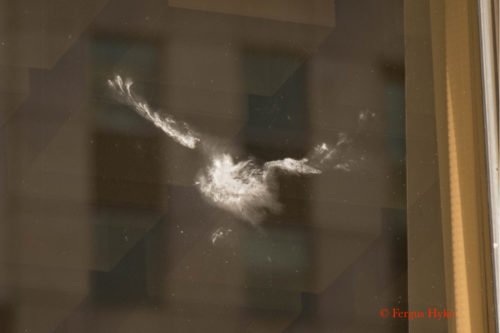
Collisions with office windows take their toll on peregrine falcons. Here is the dust print left behind by the fledgling “Hope” after a window collision in Tacoma. She suffered multiple fractures. (Fergus Hyke)
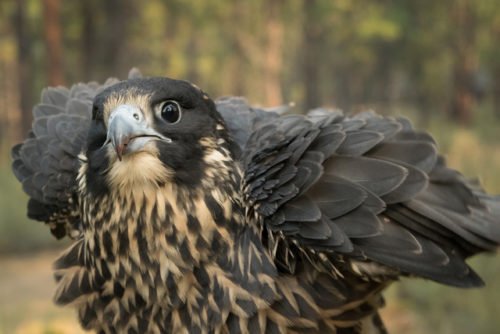
After a long rehabilitation, Hope will never live in the wild again. She is now at the High Desert Museum in Oregon as part of their education program. (Jon Nelson)