
URC Update | October 2026
2026 Seattle Cooper’s Hawk Project: Annual Report
The 2026 Cooper’s hawk nesting season once again kept our volunteers busy for almost six months. Seattle’s urban Cooper’s hawk population continues to grow, with no signs of reaching its limit.
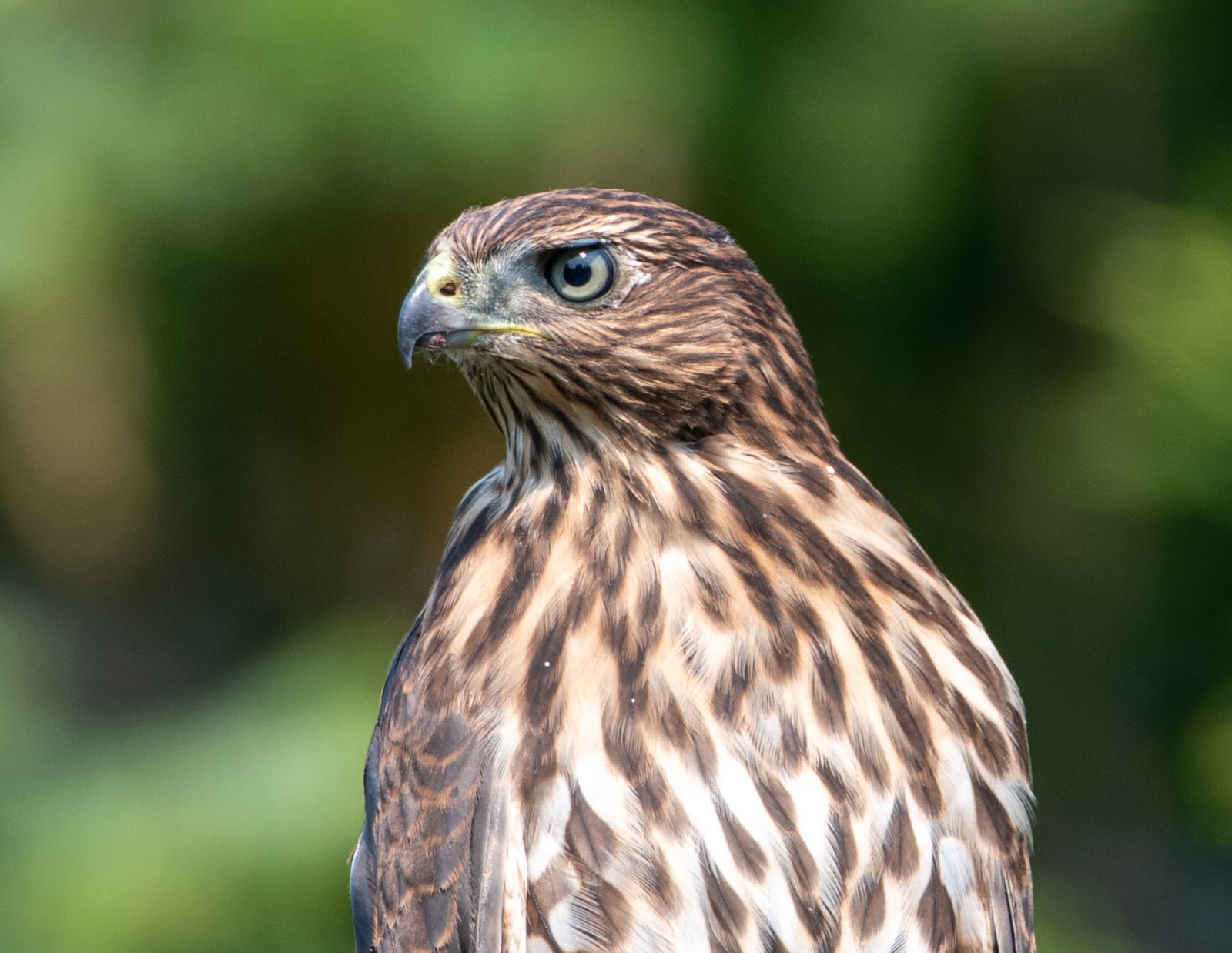
(John Gossman)
The 2026 Season at a Glance
Study area: Seattle, 83.9 square miles
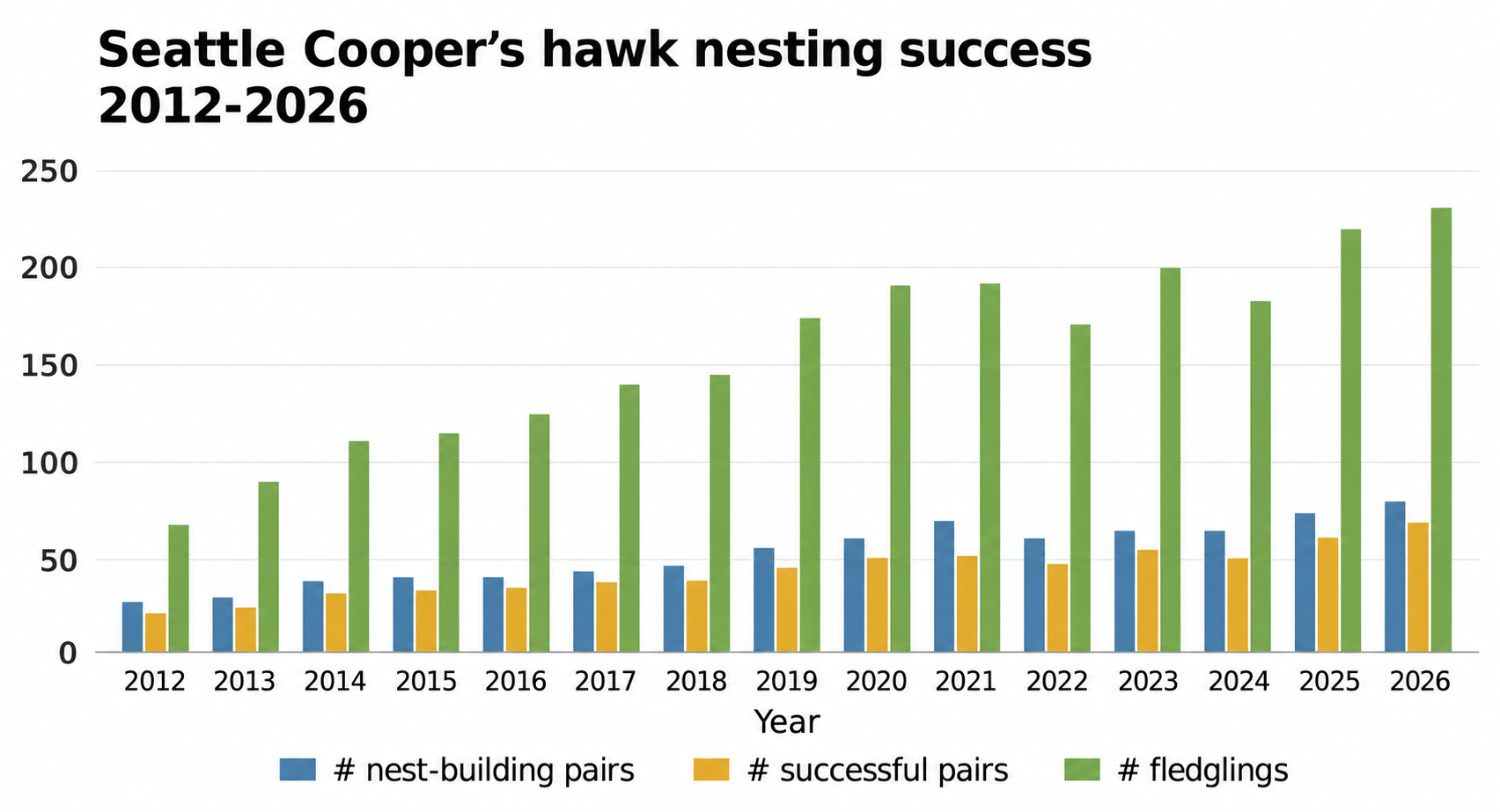
- 80 sites with nest building, ~1 per square mile
- 69 sites with fledged young
- 231 fledglings, averaging 3.35 per successful nest
- 42 banded
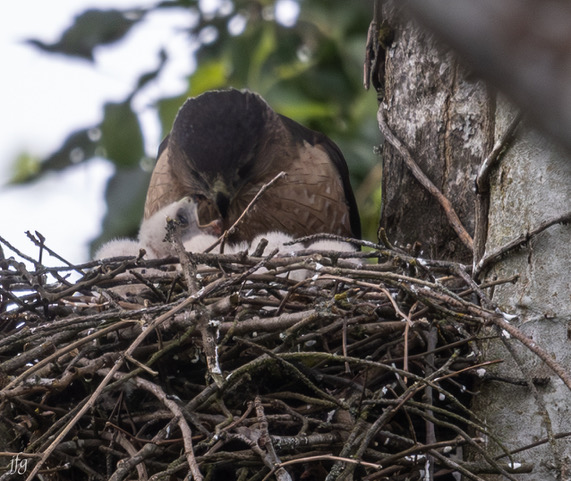
Adult female with downies in nest (Jeff Graham)
Protecting Active Nests
The Migratory Bird Treaty Act (MBTA) is an international treaty to protect birds. It forbids disturbing an active nest without a permit. In 2025, a Wallingford nest failed because of ill-timed, ill-advised, illegal tree trimming. That experience sensitized our field crew to signs of pending tree work near active nests.
In 2026, volunteers helped avert tree trimming at four nest sites. At a north Seattle park, Jeff Graham noticed a crew about to begin cutting and alerted the work crew before the nest was disturbed. Instead, Seattle Parks workers cordoned off the area and posted informational signs around the nest until the young had fledged. Similar nest disturbances were averted until the young had fledged by Darwin Nordin at two West Seattle sites, and by Elaine Chuang at a Queen Anne site. Nice work, all!
Nest Failures
- Not every nesting attempt succeeds, but failures are uncommon. In 2026 we recorded 11 failures, which occurred during nest building (4), incubation (4), or after hatch (3). We don’t know their causes, but in past years nests have failed from:
- Collapse in windstorm
- Provisioning male killed by window strike (1) or bald eagle (1), female abandoned eggs
- Predidation of eggs by raccoon
- Suspected predidation of nestlings by a barred owl
- Human disturbance
Banding Stories
Our banding program gives us a remarkable window into the lives of individual urban Cooper’s hawks. Over the past 15 years, banders have placed color identification bands on 740 Cooper’s hawks.
We have received 1,075 re-sightings of 322 different birds, an impressive 43.4% return rate. These sightings tell us that most of Seattle’s urban Cooper’s hawks are nonmigratory.
Of over 1,000 re-sightings, only three came from south of Tacoma—one each from Oregon, California, and Nevada.Supermom D/2. While most Coops are intensely loyal to the same nest territory each year, a few move around.
Female orange D/2 was banded as an adult in July 2020 near her nest at Union Bay Natural Area, where she fledged four each in 2020 and 2021.
In early 2022, she moved to nearby Laurelhurst Playfield, where she nested in 2022 (four young), 2023 (three), 2024 (three) and 2025 (three).In early 2026, she moved to her third territory, nesting near the Wedgwood pool and fledging three. Whatever her motivation for relocating, it has worked for her: 24 offspring so far!
K/2 courts two males. This spring volunteers discovered a banded adult female, K/2, courting two males in adjacent territories. She eventually picked one male and fledged five.
The other male recruited a new, second-year female. The nest failed during incubation, but the “loser” male is likely to have contributed his genes to the nest that was provisioned by the other male. This is the fourth time we have documented a banded female courting two males.*
*Deal et al. (2017). Journal of Raptor Research, 51:83-84.
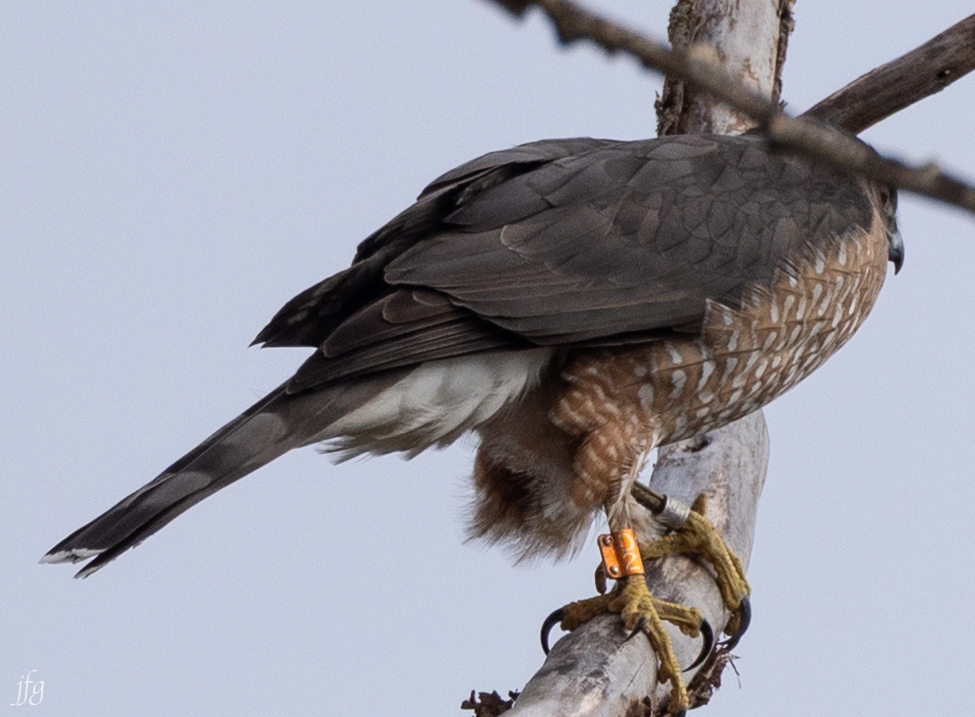
Adult female Cooper’s hawk orange D/2 (Jeff Graham)
Hatch Year and Second Year Coops
One-year-old Cooper’s hawks—mostly females, rarely males—sometimes nest while still in their juvenile plumage. Hatch year (HY) refers to young birds in their first calendar year of life. On January 1 they enter their second year (SY). The molt from juvenile to adult plumage happens over several months in the summer.
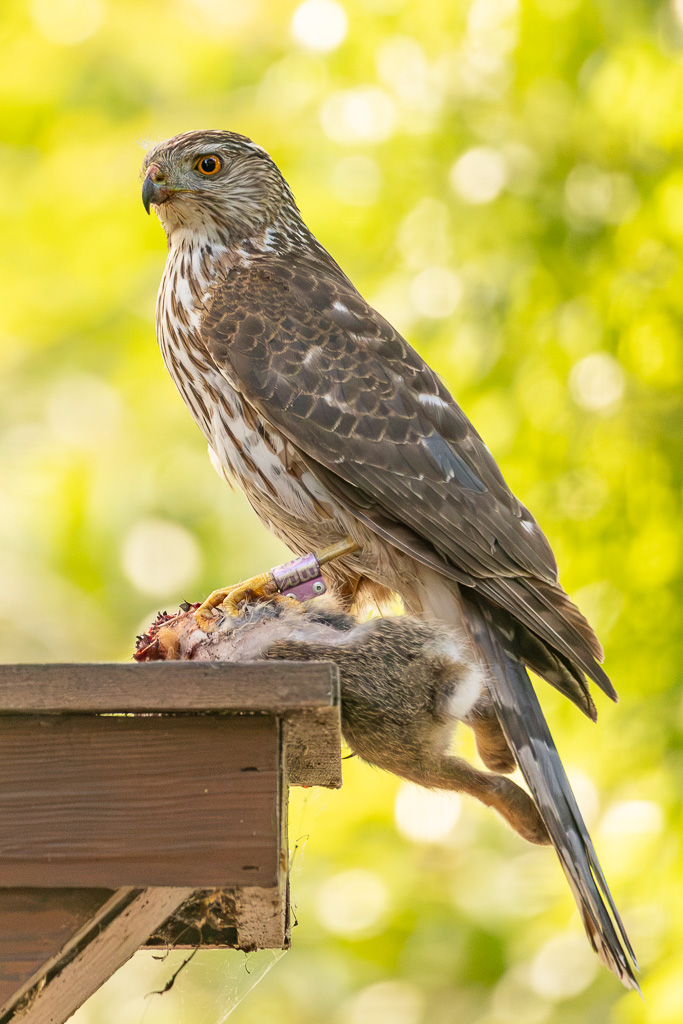
(Stephanie Colony)
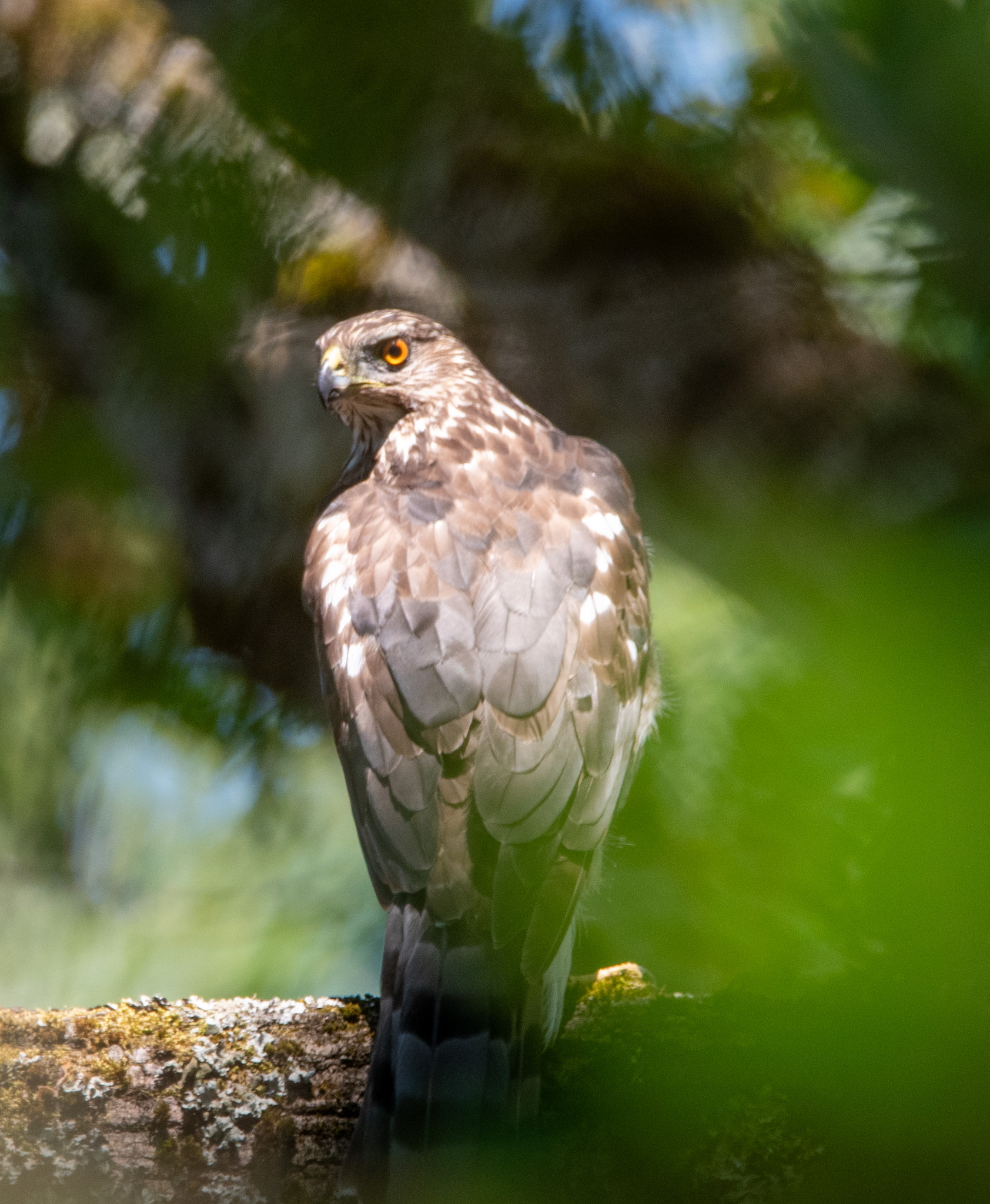
(John Gossman)
Left: SY male just starting his molt into adult plumage (note the single dark gray adult feather on his back).
Above: SY bird later in the season, with multiple adult gray feathers.
Most breeding Cooper’s hawk pairs are adults, but a few are SY females with adult males. SY pairs and SY males with adult females are rare, but we found one such pair this year, and they fledged three young
Will Seattle’s Urban Cooper’s Hawk Population Keep Growing?
Fifteen years ago, we followed 28 nests inside the Seattle city limits. Twenty-two nests succeeded, producing 68 young. Fast forward to 2026: volunteers tracked 80 nests, of which 69 were successful, producing a whopping 231 fledglings.
Two main factors are predicted to limit continued population growth in Cooper’s hawks: nest sites—primarily suitable trees—and prey abundance. So far, neither appears to be limiting Seattle’s urban Coop population.
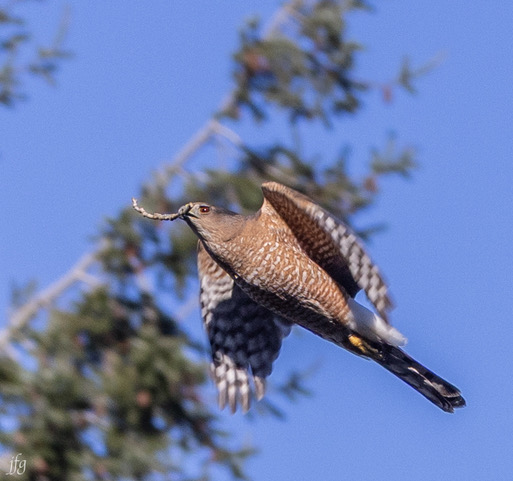
(Jeff Graham)
We have documented nesting in 23 tree species, mainly in the Olmsted Plan’s Seattle parks and in residential areas. Prey is abundant in cities, and the Coop’s rural reputation as a chicken hawk has been enhanced in cities by its prey choices of songbirds and mammals, especially rats.
There are two predicted consequences of an increasingly dense population. As a population approaches a region’s carrying capacity, competition should increase. One prediction is that young (second year) females will be pushed out of the breeding population, or into marginal territories, by dominant adult females. We have no evidence of that yet. In 2026, 16 (20%) of the 80 nest-building pairs had a SY female.
Another predicted consequence of increasing density is that territories will become smaller and closer together, forcing birds to spend more time defending them and less time hunting and rearing young, thus reducing productivity. We have not seen evidence of either increasing conflicts or reduced productivity.
Ian Newton (1998). Population Limitation in Birds.
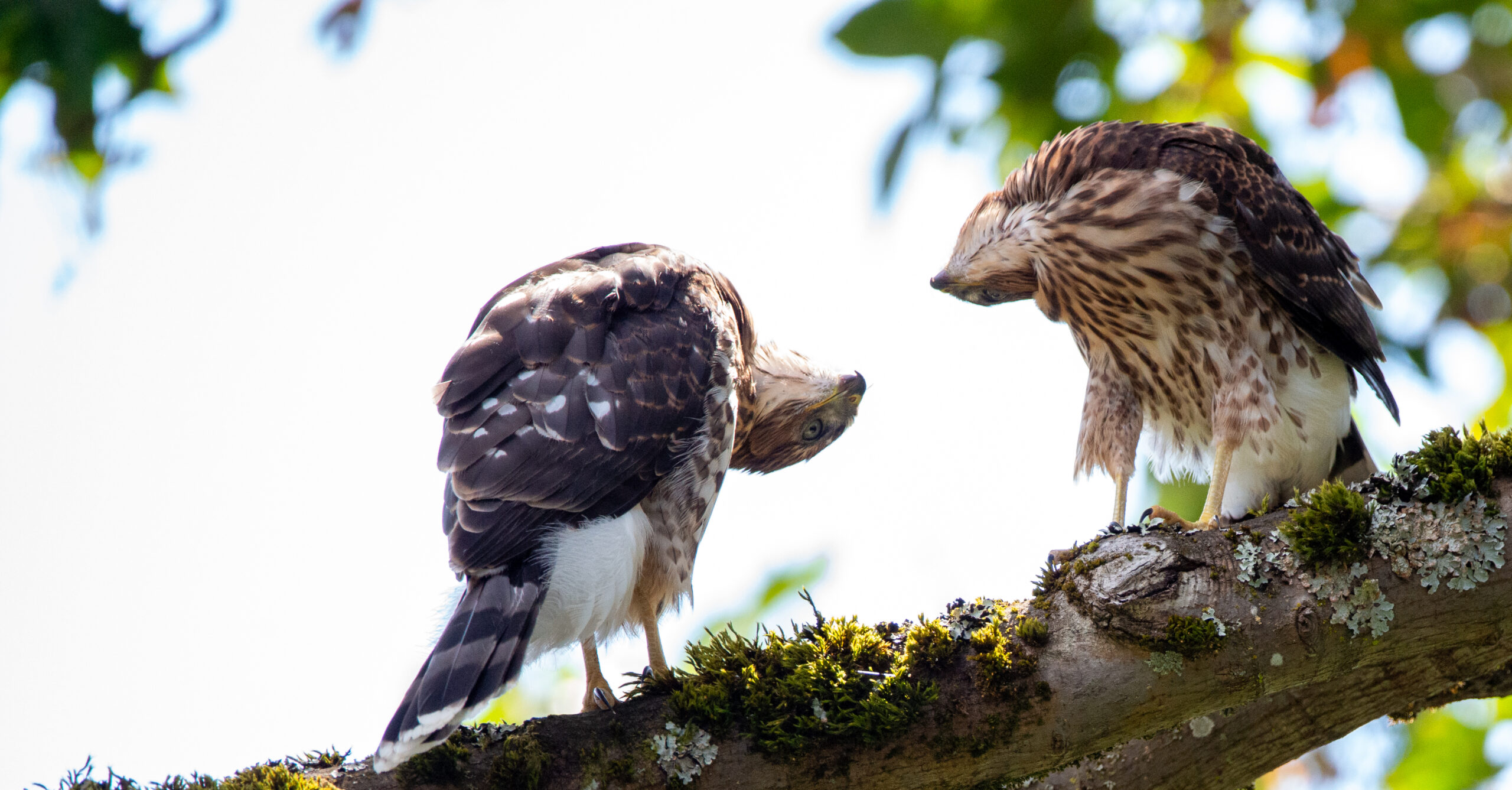
As volunteer Don McCall put it, “It can become almost an obsession trying to solve these puzzles, in a fun/demented sort of way” (John Gossman)
From Vermin to Valued Urban Predator
The Future
The 2026 season leaves us with many questions:
- How large can Seattle’s urban Cooper’s hawk population become?
- Will competition eventually force SY females out of the breeding population?
- Will shrinking territories eventually reduce productivity?
- How will climate, development, tree loss, and chnages in the urban landscape affect nesting success?
- What can long-term banding records tell us about survival, territory fidelity and dispersal?
The public attitude toward Cooper’s hawks has markedly improved in recent years. A glimpse into their former reputation comes from Bent’s (1937) Life Histories of American Birds of Prey:
“If the Sharp-shinned hawk is a blood-thirsty villain, this larger edition of feathered ferocity is a worse villain, for its greater size and strength enable it to do more damage… It is essentially the chicken hawk, so cordially hated by poultry farmers, and is the principal cause of the widespread antipathy toward hawks in general.”
Today, Cooper’s hawks are not merely tolerated members of Seattle’s bird community, they have become a familiar and largely welcome part of the urban ecosystem. Their recovery and expansion provide an opportunity to observe, over time, predator-prey relationships, adaptation, territorial behavior, and population dynamics in a city environment.
Ed Deal & Patti Loesche