
URC Update | January 2026
2025 Urban Raptor Conservancy
 Annual Report
We started Urban Raptor Conservancy in 2018 mainly to help fund a large, expensive study of the prevalence of rodenticides in western Washington raptors. We created a website that assembled, for the first time, information about the raptor species in our region, not just the subjects of two long-term studies, urban Cooper’s hawks (since 2002) and peregrine falcons (since 1994), but also the Seattle Merlin Project.
Your response to URC was enormous and unexpected. Who knew that so many people were so excited about raptors in the city? With over 100 individual donations and several grants, you supported our rodenticide study. Many, many of you contacted us for help with identification (Coop or sharpie?), or to report seeing a Cooper’s hawk, a raptor’s ID band, a wayward fledgling, a previously unknown nest site, a potential human-raptor conflict. We have interacted with hundreds of you online and in the field. Now in our ninth year, our core mission continues: how can we support urban raptors as valued and valuable members of our cities?
This report reviews our work on behalf of urban raptors in 2025.
Seattle Merlin Project
A highlight of the season was the discovery that a banded merlin, blue right P-H, was the adult male at a nest site in North Seattle. In 2023, P-H was found on the ground as a nestling, taken to PAWS Wildlife Center, banded by URC, and released back to his family. This season, about 3.5 miles from his natal site, two-year-old P-H and his mate reared three young of their own, along with an orphaned male fledgling released at the site by PAWS. The introduced fledgling, blue left P-M, thrived with his foster family and was photographed 10 days post-release.
Merlin courtship activity will begin in late winter/early spring. If you see or hear merlins in or near Seattle, please report your sightings to URC (info@urbanraptor.org). If you’re interested in volunteering as an observer for the study, please contact Kim (kim.mccormick@comcast.net).

Left: Male merlin blue right P-H, rescued as fledgling in 2023, photographed as a nesting adult in 2025 (Kim McCormick)
Right: Male blue right P-M, an orphaned fledgling in 2025, was successfully reared as a foster in P-H’s family (Kim McCormick)
Banding News
Bird banding is regulated by the USGS Bird Banding Lab (BBL), which provides aluminum federal bands with unique codes to licensed banders. Our research projects allow us to also use more legible color VID (Visual IDentification) bands to identify individual raptors. When you see a banded raptor, think of URC!
In the Field
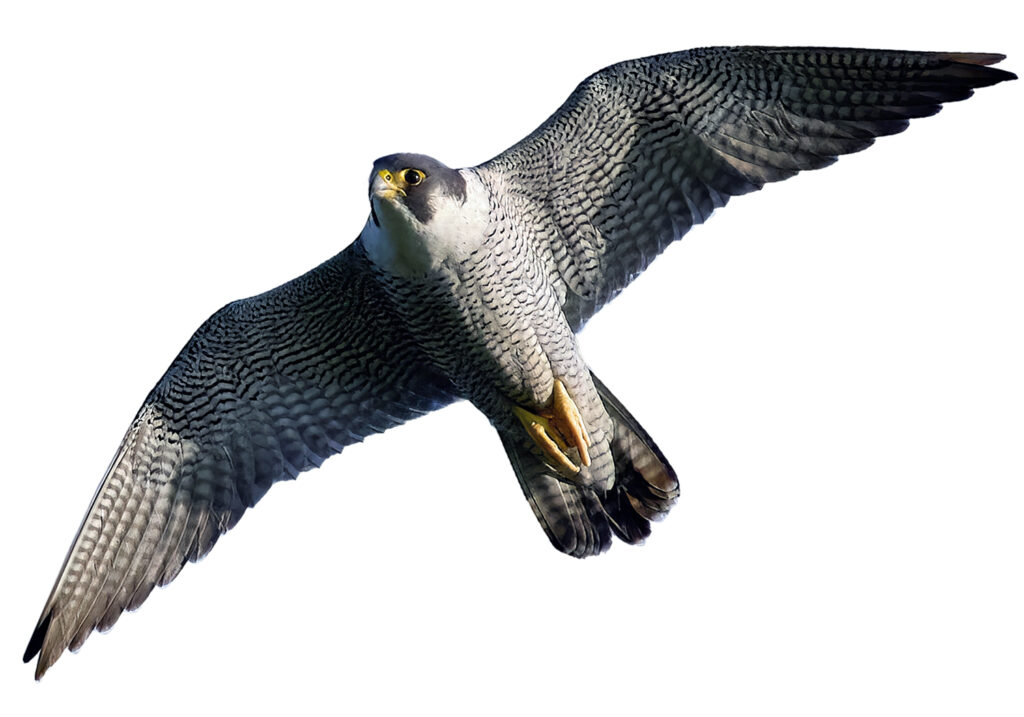
We banded 70 Cooper’s hawks in the field last year (males: purple left leg, females: orange right). Overall, 691 Coops have been banded, and observers (you out there) have resighted 308 different birds (1014 resightings!)—an impressive return rate of 45%. Coops stick around. In 2025, 11 young peregrine falcons got black VID bands. Six were banded in the nest, two at the West Seattle high bridge and four at the AGC building on South Lake Union (thank you, SDOT and AGC). Five rescued peregrine fledglings were banded while at the PAWS Wildlife Spa. Of the 10 merlins banded (blue) by URC this year, four were banded in the field.
Rehabilitated Raptors
We band all rehabilitated raptors at PAWS before their release. In 2025, 69 rehabbed raptors (eagles, hawks, falcons, and owls) received federal bands, and five species were color-banded: Cooper’s hawks, peregrines, merlins, bald eagles (green over black), and barred owls (blue). We have stopped color-banding barred owls because the VID bands are difficult to see in live birds; the few resightings we did have were all very near where the owls had been found and released.
New in 2026: Bluetooth Telemetry in Fledgling Peregrines
Where do fledgling peregrines go when they disperse from their natal territory? For the last two years we have been working on that question, using lightweight solar transmitters from Cellular Tracking Technologies (CTT) on the VID bands of young peregrines. 2026 looks like a game-changer. CTT has developed ultralight (1-g) leg bands embedded with battery-operated 2.4-GHz transmitters that can be read by a cell phone! Especially in an urban area, this method promises far more precise data on the movements of young peregrines than has ever been available before. We band nestlings at several Seattle nest sites, as well as healthy rehabbed peregrines from PAWS Wildlife Center. We hope the use of the latest CTT technology, such as the radio bands, will provide new insight into the early stages of fledging through dispersal.
Threats to Urban Raptors and URC’s Response
When we watch raptors in the city, we inevitably encounter the consequences of urban challenges, including collisions, entrapments, entanglements, poisoning, nest disturbances, and tree removals, along with natural problems such as falling from the nest and unsuccessful fledging. The hidden costs of all those free pigeons! Here are a few updates on this year’s experiences.
Window Collisions
Up to a billion birds a year die from window collisions, almost half in residential areas. Among urban Cooper’s hawks and peregrine falcons, window hits are the most common cause of death. Many of us have direct experience of a bird hitting our window.
Birds that do not die immediately may fly off, but the consequences of a window hit often continue after the bird is out of view. URC received a grant from the West Seattle Garden Tour to raise awareness of this problem and to promote bird-safe glass products, targeting West Seattle homes. This summer URC hosted a table at the garden tour to publicize our work and solutions to window collisions. With Birds Connect Seattle, URC will install bird-safe products on windows in selected West Seattle homes.
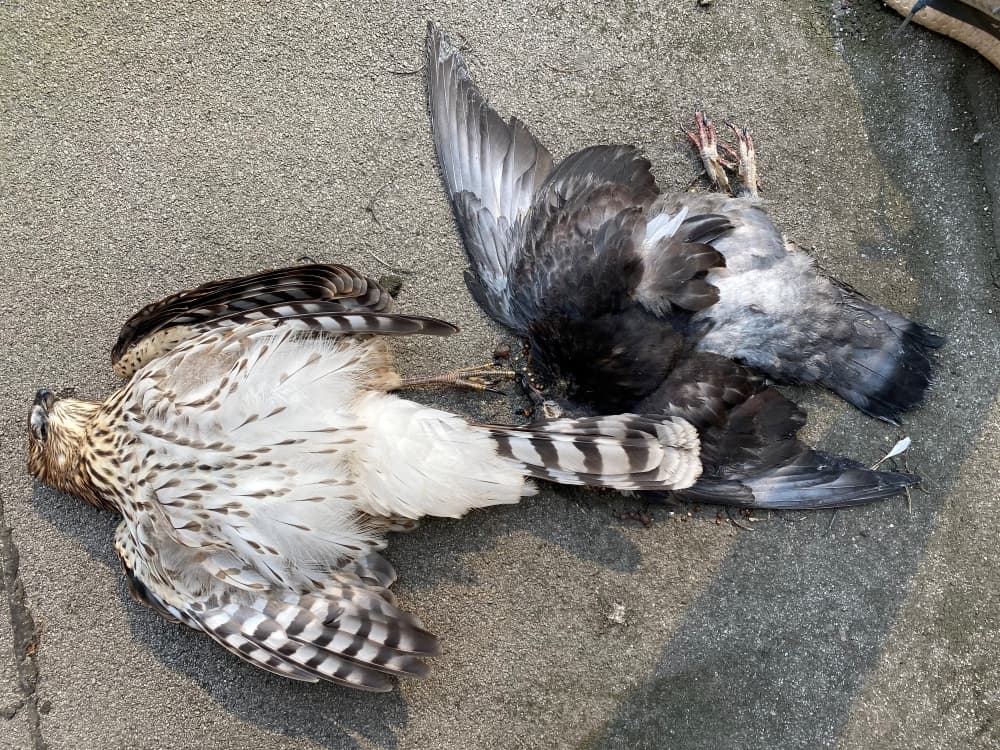
A young Cooper’s hawk chased a pigeon into a window, which killed both (Patti Loesche)
Building Entrapments
Every year, we hear from businesses about a raptor, usually a Cooper’s hawk, trapped in a warehouse or other large indoor space. The panicked bird problem-solving consists of repeatedly flying up to, and often into, a skylight or clerestory window. Once trapped inside, Coops seldom figure out how to fly out the same way they came in. Ed Deal rescued one such Cooper’s hawk at Ghostfish Brewing in Seattle’s SODO neighborhood. The Coop gained its freedom and Ed gained some beer.
Less happily, Arizona Tile in reported a trapped Cooper’s hawk in their Tukwila warehouse for the sixth year in a row. The skylights do not open, nor are there curtain barriers at the open warehouse doors; as a result, trapped Coops there have become an unfortunate tradition. This one didn’t make it out.
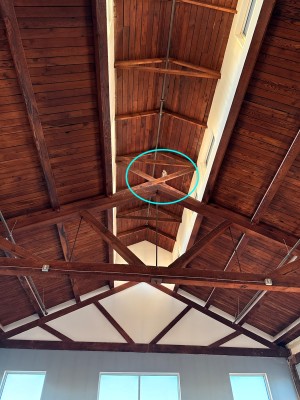
Young Cooper’s hawk at Ghostfish Brewery and looking for the exit (Ghostfish Brewery)
Peregrine falcons also find their way into buildings. At the Veterans Affairs Medical Center on Beacon Hill, four adult falcons in as many years became entrapped inside a glass courtyard with an open roof. Pigeons are attracted to an adjacent sod roof, and peregrines chase the pigeons, sometimes into the courtyard. One escaped and URC rescued the other three. At least one of these entrapped peregrines was a breeding male from West Seattle whose mate left her eggs unbrooded to wait overnight for him to return from his hunt.
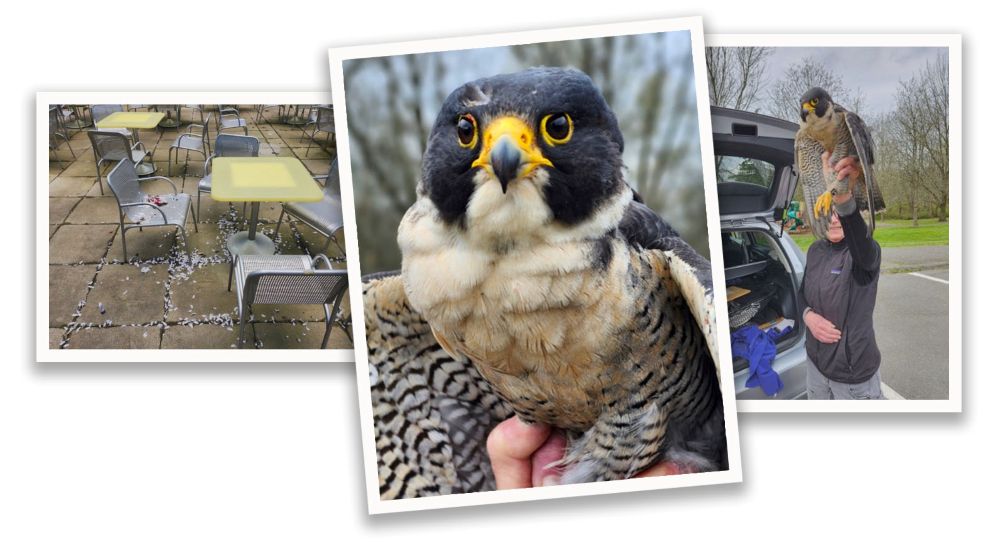
Prey remains in VA courtyard; the formerly entrapped predator was sent on his way (Ed Deal, Elaine Chang)
Entanglements
In October, Peter Anderson found a fledgling osprey entangled in a nest at ConGlobal Industries in Seattle’s SODO neighborhood, along the industrial Duwamish River. Patti assisted a local osprey expert, Jim Kaiser, with the rescue, indispensably aided by last-minute help from lift operator Troy Coleman of Flynn Industries, who was working on a nearby building. With Flynn’s and ConGlobal’s permission, Troy was at the nest site in minutes. Patti joined Troy in the lift and cut the osprey loose. The entanglement consisted entirely of human detritus: fishing line, poly cord, wire and plastic. The young bird did not survive its injuries.
Steps are being taken to prevent future such tragedies before the ospreys return in the spring. URC met with Port of Seattle’s George Blomberg and Jenn Stebbings to discuss osprey nests on Port property, and the group exchanged ideas on how best to monitor and manage osprey nests on Port property.
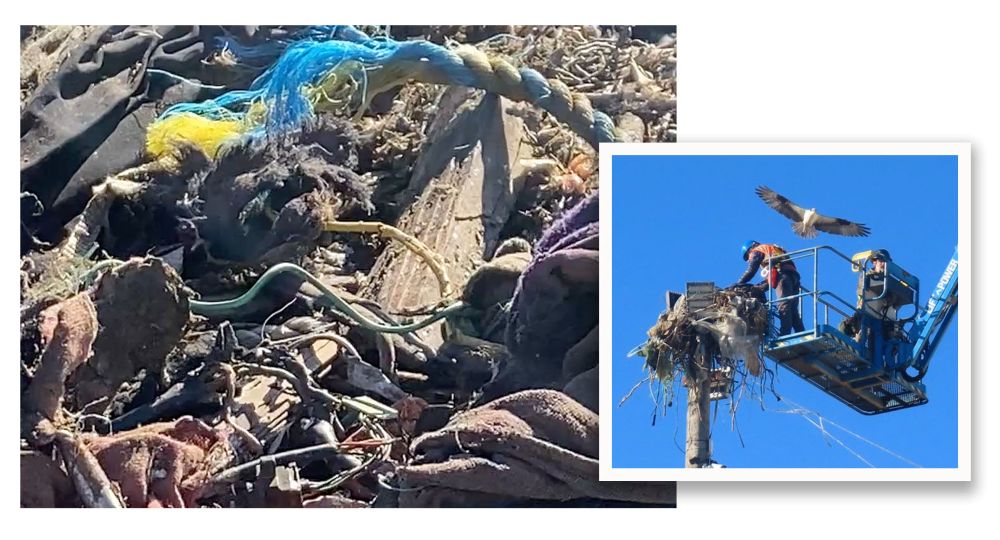
Left: This osprey nest consisted entirely of human detritus (Troy Coleman) Right: Patti, Troy Coleman, and concerned dad osprey approach entangled fledgling (Peter Anderson)
Rodenticides and Raptors
We extended our study of rodenticides in western Washington raptors to add peregrine falcons from the last two breeding seasons, increasing our peregrine sample to 20. Although peregrines are uncommon rodent-eaters, we found concentrations of second-generation rodenticides in this species in nestlings and fledglings. With analyses finally complete, we are close to submitting a manuscript for publication.
URC was contacted by the Center for Biological Diversity about our study results. CBD is leading legislative efforts to regulate rodenticides in Washington State. On January 15, HB 2516 was introduced to the state legislature to establish a moratorium on certain rodenticides.
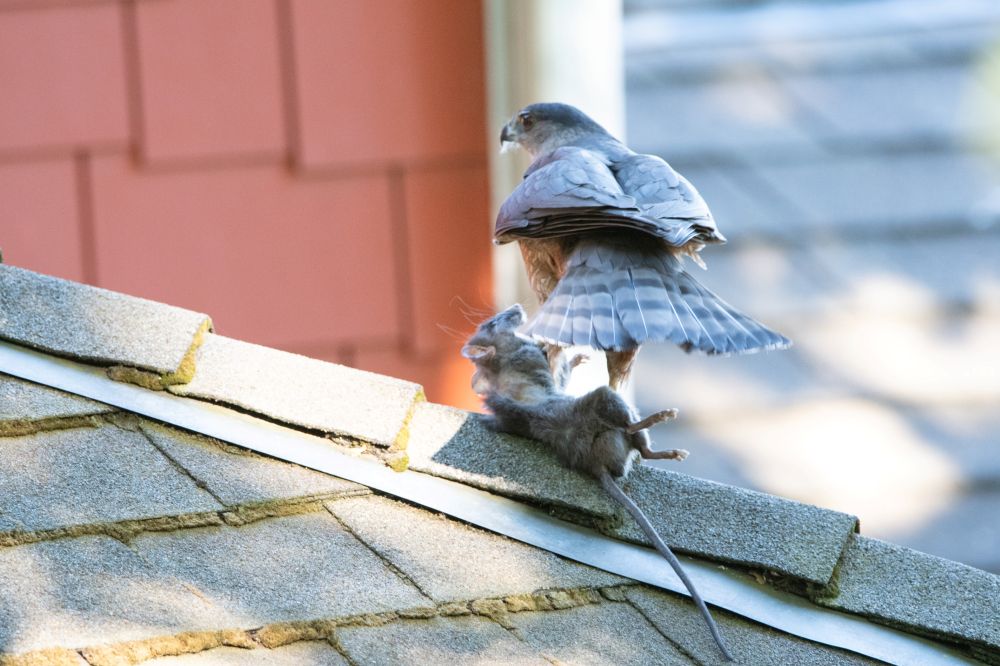
Adult Cooper’s hawk captures a rat for its young (John Gossman)
How Your Contributions Supported
Our Urban Raptors in 2025

Thank You!
As Urban Raptor Conservancy enters its ninth nesting season, we remember that we are doing this with you, our many supporters, volunteers, donors, and friends. You continue to make this endeavor possible. Thank you all.
Patti Loesche & Ed Deal