
URC Update | December 2025
2025 Puget Sound Peregrine Project: Annual Report
The first 48 hours after an urban peregrine fledgling leaves its eyrie are perilous. Unlike wild eyries, most urban nest sites—under freeway bridges, on skyscrapers—offer scant room for movement and few safe ledges to hop to. A new fledgling will probably glide better than it can fly, and in early flights, it often fails to stick the landing. These inaugural gauntlets often result in injury or death. Sometimes quick-thinking volunteers can orchestrate a rescue from risky situations, with the intention of returning the fledgling to its parents. However, reunions are also risky: will the parents allow their young to come back? With rare exceptions, the answer is yes, a life-saving reward.
2025 Urban Eyries
Seattle: two buildings, two bridges
Portage Bay Bridge
Closed
King Street Station (KSS)
3 fledged, 3 rescued, 3 died
AGC of Washington (AGC)
4 fledged, 1 died (+ 2 transient fosters, rescued)
West Seattle Bridge (WSB)
2 fledged, 2 rescued, 2 reunited
I-90 Lacey V. Murrow Bridge (LVM)
4 fledged, 4 rescued, 1 died, 3 reunited
Tacoma: one bridge
Vulcan Metals
3 fledged
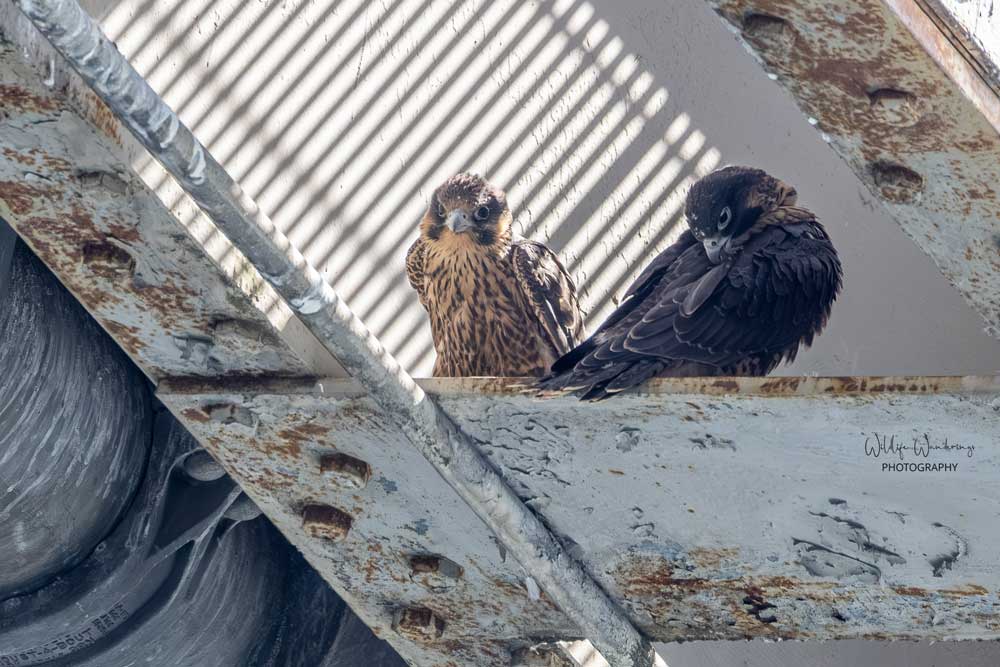
Two of the four LVM eyasses consider their next move (Rue Cvetovac)
2025 Breeding Season
Portage Bay Bridge. Peregrines have nested under this bridge since 2020. It’s a terrible site; fledglings drown or die in traffic each year. Last winter, Washington State Department of Transportation began its scheduled bridge replacement, and their environmental team worked with URC to close the nest site. However, the nest was not excluded until the resident pair was ready to lay, causing peregrine confusion. The pair lingered for weeks before eventually leaving.
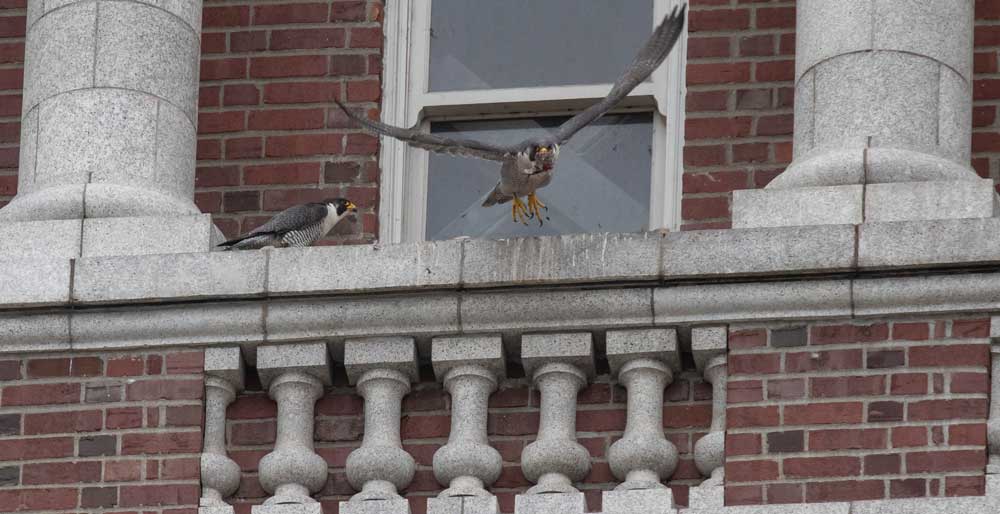
Adults feeding young at the King Street clock tower in early May (Jim Riley)
King Street Station (KSS). First to hatch but last to be discovered, the KSS clock tower was a new downtown site within the same territory as the historic 1201 3rd Ave nest. Given the monthslong roof work at 1201, it’s likely that the 1201 pair moved to KSS. A serendipitous sighting at KSS in May of an adult peregrine delivering prey led to the discovery of the eyrie—and three eyasses about 3 weeks old.
Unexpected rejection. The three, all females, fledged in early June. One flew confidently, but the other two didn’t and required challenging rescues. They were taken to PAWS Wildlife Center, where one received a fatal diagnosis (trichomoniasis) and was euthanized; the other, banded 41-V, remained at PAWS until she was released back at the clock tower after seven days for an expected reunion with her parents and sister. Oddly, no one came to the nest site on her release day. Instead, the parents discovered her 24 hours later, and in a heartbreaking twist, they rejected her, repeatedly stooping and driving her away. After that non-reunion, 41-V was no longer fed by her parents. Although she scavenged from her sister and the two remained close for a couple of weeks, 41-V eventually starved.
No survivors. Around the same time, the KSS mother disappeared and is presumed dead. In early July, the surviving fledgling from the brood, the one who had fledged successfully, followed her sisters to PAWS with broken bones from a probable window hit and did not survive. Tough start to the season.
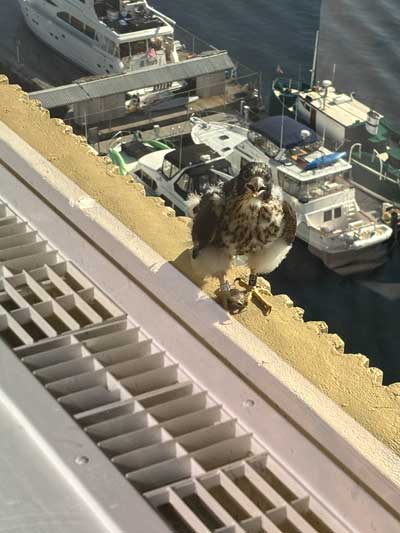
SeaTac foster #1(23-V) the day of his arrival at AGC (Anne Hilton)
AGC of Washington. This South Lake Union building has been home to the same pair since 2021. It’s the safest site in the city: secluded upper-floor nest box, spacious balcony, and nearby safe landing places for awkward fledglings. Four eyasses hatched, but the most precocious one was lost just before fledging to overconfidence, and it drowned. Meanwhile, at a SeaTac hangar, an eyass was found on the ground below its nest. Peregrines are bad tenants in hangars… The AGC parents were now feeding only three, and they would consider any unflighted youngster at the eyrie their own; along with an unlimited supply of pigeons, this eyrie seemed like a great foster home.
Foster debacles. In early June, SeaTac foster #1 joined his new family with hardly a hitch, prompting an extension of the AGC foster program to SeaTac foster brother #2 the next day. Right after that, the AGC-born siblings all took off in perfect first flights. Inspired, the two fosters, although a week younger, tried to fly too. Both ended up grounded and flightless, and after a couple of madcap rescues they were off to PAWS. There they reunited with SeaTac sibling #3, and all went to a falconer in eastern Washington for hunting school. In late fall, all three siblings were released to the sky.
Dispersal. The three AGC-born fledglings hung around South Lake Union for a few weeks until they gradually disappeared. In late July, male 15-V showed up in West Seattle, 8 miles from home. In early August, female 49-V was still begging from her mother as she hunted pigeons in nearby Belltown. Barely a week later she was photographed in Westport, WA, 80 miles away.
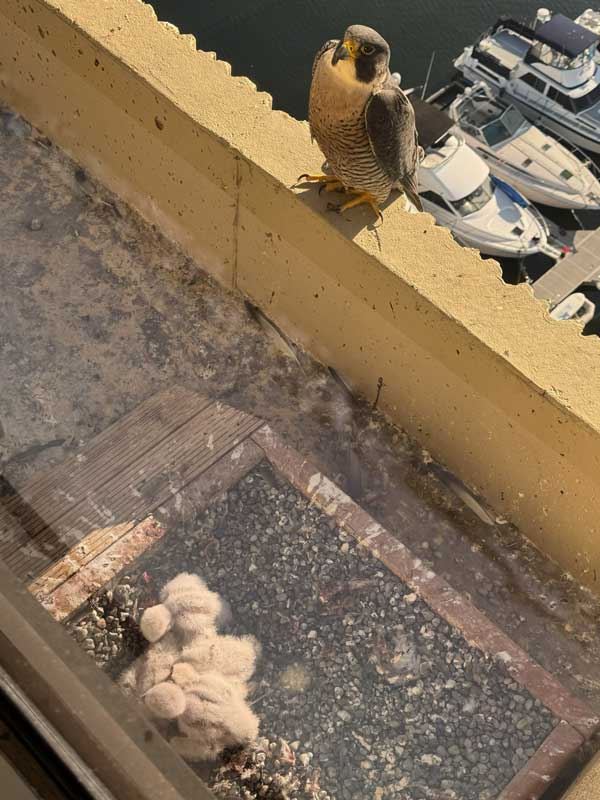
AGC eyasses with mom in early May (Anne Hilton)
West Seattle Bridge (WSB). This eyrie overlooks the low Spokane Street Bridge, industrial traffic on West Marginal Way, a trucking yard, and the Duwamish River. Two fledged from this unwelcoming site, each by falling out of the nest and gliding into the road, being narrowly rescued, and shuttled to PAWS. With no young on site, we were anxious to bring the fledglings back before their parents lost their parental urges.
Reunions the way we like them. Male 16-V returned after five days. Although he had not flown in rehab, he crossed the Duwamish four times on inaugural flights. His sister, 40-V, was released six days later at a hastily arranged site in the Seattle Public Utilities yard (thank you, SPU!) near her brother’s new hangout. She tentatively emerged from her carrier; mom flew benignly over her and perched on a nearby pole: acceptance. 40-V’s begging attracted her brother’s attention, and he too flew over, gently stooped—a greeting—and perched near her. They looked at each other, 16-V slowly moving closer. 40-V suddenly took off and landed on a warehouse roof, her brother right behind. They hopped around each other, dancing, chasing, wings spread, reunited.
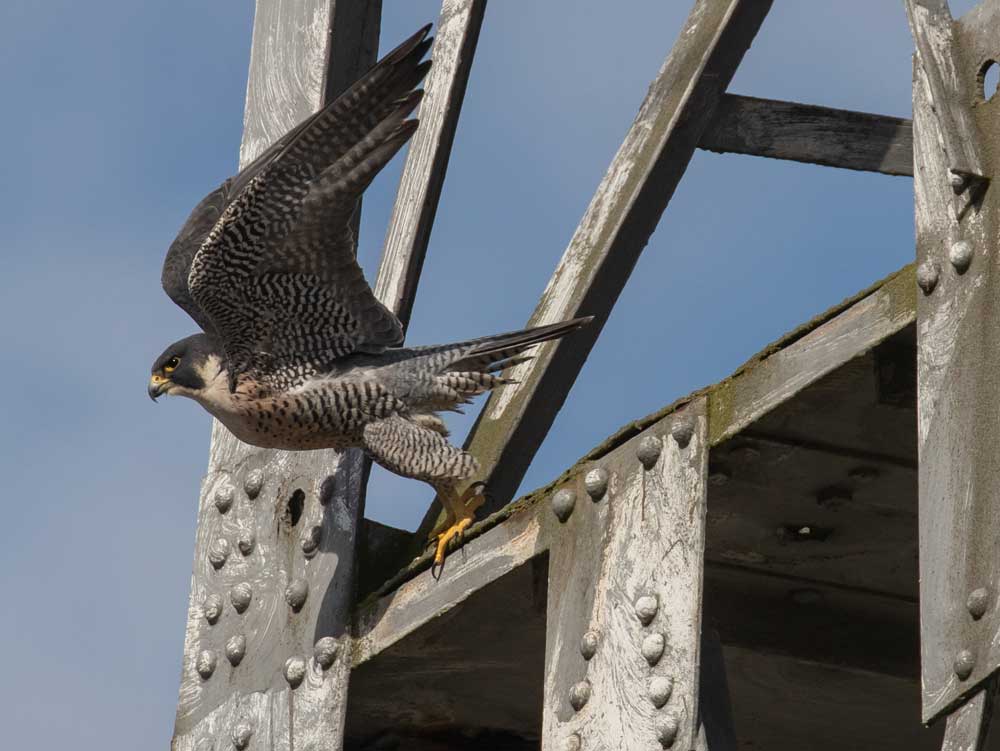
Adult female takes off from tower at West Seattle Bridge (Jim Riley)
I-90 Lacey V. Murrow (LVM) Bridge. This fourth Seattle eyrie was chosen by a late-nesting pair. Four fledged in early July, all into Lake Washington. Thanks to many hours of volunteer vigilance, all were rescued (including two by kayak!) and went to PAWS. One did not make it; the three survivors were brothers 21-V and 21-BH and sister 42-V.
Harrowing reunion. Three survivors meant three reunions. In mid-July, the brothers were successfully reunited first, but their sister’s reunion didn’t go as easily. Instead of flying to the bridge eyrie upon her release, 42-V roosted inland on rooftops. This location seemed to baffle her parents, who flew benignly overhead but did not feed her. The standoff lasted three days, and 42-V became visibly weaker. On the fourth day, mom flew overhead with a pigeon and the brothers in pursuit. For the first time, 42-V joined the chase. She was found moments later on another rooftop by the lake shore—eating that whole pigeon. 42-V was back in the family.
To disperse, or not to disperse? In early August, the SEA Airport Strike Avoidance Program found 21-V in a trap at the airport, nearly 10 miles from home. Because he was still being fed, we released him back at the bridge. Throughout September, the brothers regularly hunted shorebirds at the Cedar River mouth, 8 miles down the lake, returning home to roost. By early October, two fledglings were gone. As of Thanksgiving Day, 21-V was still hanging with his parents at the bridge.
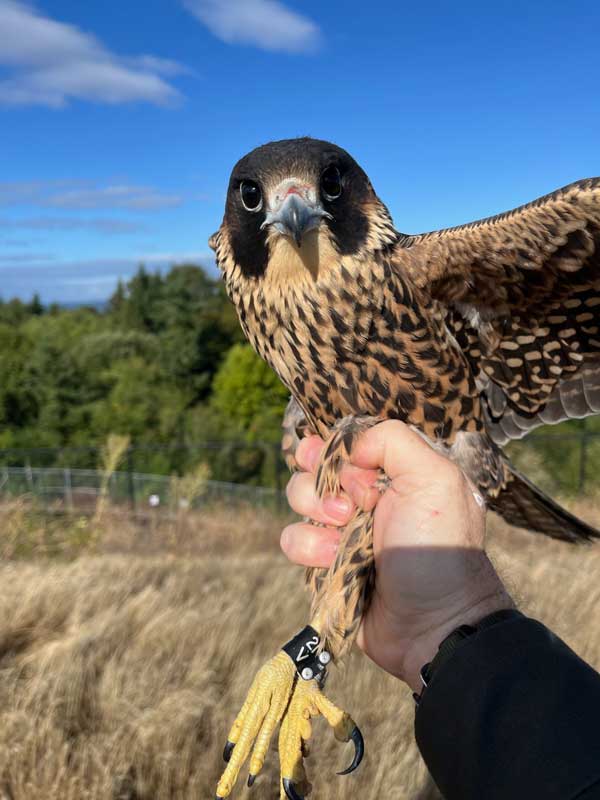
Male 21-V’s first dispersal attempt led him into a trap at SeaTac’s Raptor Strike Avoidance Program (Alex Lauber)
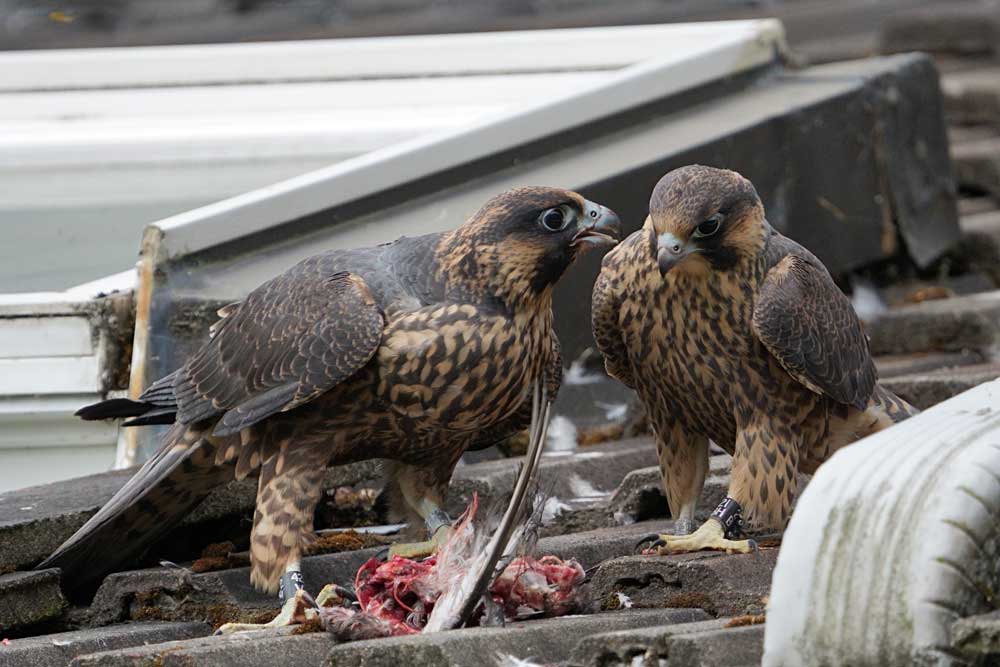
Sister 42-V finally eats a pigeon while brother 21-BH stands by (Mariya Tikunova)
Tacoma. Roger Orness monitored three sites in Tacoma: downtown, State Road 509 bridge, and Vulcan Metals. The presumed resident downtown pair were occasionally seen in early winter, but no nesting pairs were found either downtown or at SR 509. The sole successful site was at the bridge near Vulcan Metals, where three young fledged without mishap.
CASCADE FOOTHILLS
This report focuses on urban peregrines in Seattle and Tacoma. Over in the Cascade foothills, the Cascade Peregrine Project team monitored seven wild eyries. We see urban peregrines almost daily throughout the season, but every observation in the foothills is hard won over many hours and at great distances.
King Co. (4 sites)
Snoqualmie Falls
Occupancy confirmed, eyrie not found. Fledgling seen in flight on 7/10.
Mount Si
Single adults seen several times; no occupancy confirmed.
Rattlesnake Lake
Same eyrie as in 2022 & 2023 despite new climbing gear nearby. Three fledglings seen on 6/30.
Olallie State Park
Nested late, perhaps a renesting attempt. New eyrie site was a mystery until late July, when an eyass appeared. Three fledgings seen on 8/17.
Snohomish Co. (1 site)
Arlington
Occupied, but eyrie not found & nest cycle inconclusive. Fledglings suspected but not confirmed.
Pierce Co. (1-2 sites)
Snoquera Falls
Food begging heard in late June; three fledglings seen in mid-July.
Skookum Falls
Three fledglings seen in early July, either from nearby Snoquera or a separate family.
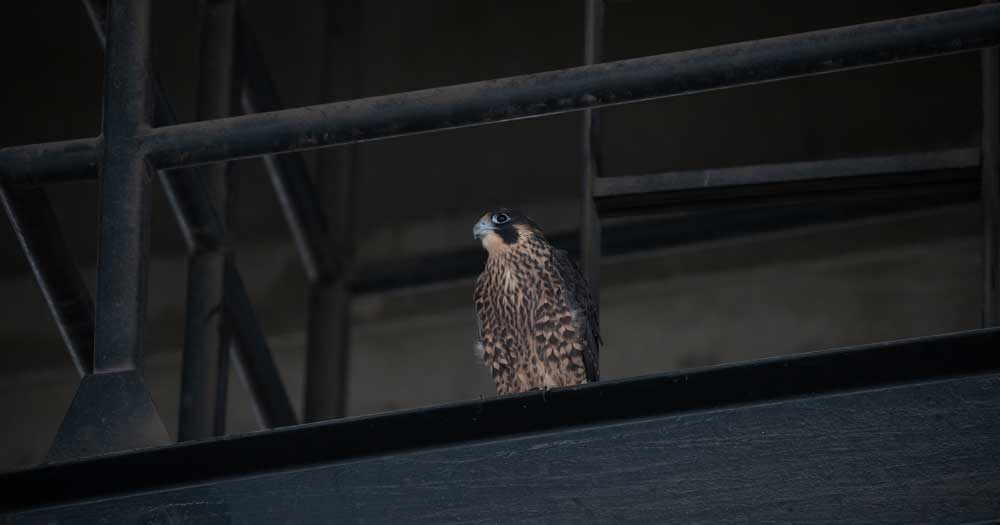
Male 16-V about to leave his West Seattle eyrie (Jim Riley)
2025 Wrapped
This season’s marathon of fledglings, deaths, rescues, and reunions ended in August. In January, the cycle begins again. Already we’ve seen peregrines at the 1201 3rd Ave nest box and pair bonding at other sites. It’s a profound privilege to witness a peregrine family’s entire breeding cycle, day in and day out, at multiple sites. What we have learned, and done, would have been impossible without the dedication of almost 30 URC volunteers and the support of many other friends of urban peregrines, including AGC of Washington, Amtrak staff, ARTS at King Street Station, Embassy Suites, Seattle and Washington DOT, Seattle Parks and Recreation, Seattle Public Utilities, Washington Department of Fish and Wildlife, Patagonia Seattle, and, not least, PAWS Wildlife Center. Thank you all.
Rebekah Graham & Patti Loesche